Quick answer: music is one of the most efficient learning activities available to a young child. It builds the sound awareness that reading depends on, carries vocabulary in both languages, trains memory and sequencing, and gives children a reliable way to regulate their own mood. You do not need to be able to sing.
Ask most adults about music in preschool and they picture children sitting in a circle doing actions. Pleasant, but not serious. Something you do while waiting for the proper work.
That has it exactly backwards. If we had to keep only three activities in a preschool day, singing would make the list.
Music is how children learn to hear the parts of words
Before a child can read, they have to notice that words are made of smaller sounds. This is called phonological awareness, and it is one of the strongest predictors of later reading.
Songs and rhymes teach it almost accidentally. Rhyme makes a child notice endings. Clapping syllables makes them notice beats within a word. Silly substitution games, the ones where every word suddenly starts with B, make them notice beginnings. None of it feels like literacy work, and all of it is.
It carries language, including a second one
Melody is a delivery system. Words attached to a tune are easier to remember, easier to repeat, and get repeated voluntarily, which is the part no worksheet achieves.
This matters enormously for Mandarin in a household where it is not the main language. A four-year-old will sing a Chinese song two hundred times without ever experiencing it as practice. Tones, rhythm and vocabulary all travel with the tune. It is the least effortful language exposure available to any family.
Rhythm is early maths and early self-control
Keeping a beat is a genuinely demanding task. The child has to hold a pattern in mind, predict what comes next, and match their body to it.
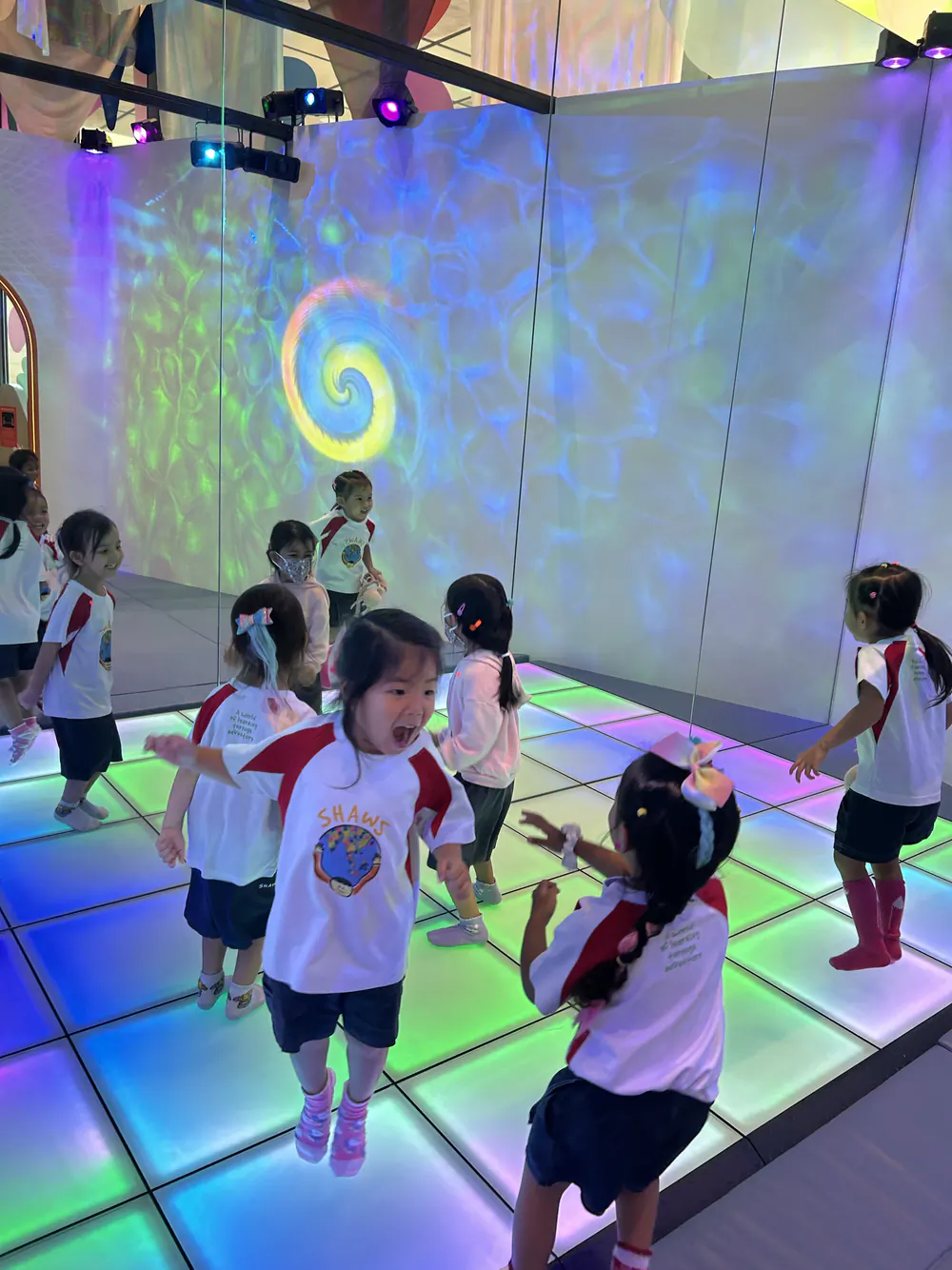
That is pattern recognition, sequencing and prediction, which are the foundations of mathematical thinking. It is also physical self-regulation: stopping on cue, going faster then slower, staying quiet through the pause. Games like freeze dance are not filler. They are some of the most enjoyable self-control training a four-year-old will ever do.
It gives children a way to manage feelings
Long before a child can explain that they feel wound up, they can respond to music that slows down.
Adults use this constantly without noticing. Children benefit from it more, and they benefit most when the same music reliably means the same thing. A particular song at tidy-up time, another at nap time, another in the car when everyone is fraying. Over a few weeks the song does the work that nagging was doing, and it does it without conflict.
It is social in a way little else is
Singing together requires listening to other people, matching them, waiting for your turn and being part of something bigger than yourself. For a three-year-old who is still mostly the centre of their own universe, that is a substantial ask, and a group song delivers it painlessly.
There is also something quietly important about a whole room of children and adults doing the same thing at the same time. It builds the feeling of belonging that makes a child want to come back tomorrow.
Using music at home, without being musical
The single biggest barrier we hear is "I cannot sing." Your child does not care and cannot tell. A parent's voice, however rough, is more valuable to a small child than a professional recording, because it comes with a face and attention attached.
Practical ideas:
- Give routines a song. Handwashing, shoes on, tidy up, teeth. The transitions that cause the most friction are the ones a song fixes fastest.
- Sing in the car and the lift. Small enclosed spaces are the natural home of family singing.
- Keep instruments where hands are. A shaker, a drum, a couple of wooden spoons and a pot. Home-made counts.
- Play a wide range. Classical, kids' songs, Mandarin songs, whatever you loved at twenty. Broad exposure beats a curated children's playlist.
- Move to it. Dancing, marching, stamping and spinning are how young children take music in. Sitting still is not required.
- Let them lead. Ask your child to be the conductor and follow their fast, slow, loud and quiet. They will take it very seriously.
What it looks like at Shaws
Music runs through our day rather than sitting in a slot. There is a song to gather, a song to move outside, songs in English and Mandarin, instruments available during free play, and a great deal of unscheduled dancing.
Children who are shy in conversation will often join a song first. Children who struggle to sit will hold a rhythm. It is one of the few activities where every child in the room can take part at their own level at the same moment, which is worth more than most timetabled subjects.
None of this is decoration. It is some of the most efficient teaching we do, and the children think it is a party.
Shaws Preschool has been filling its classrooms with music, movement and play across the East Coast and Serangoon since 1989. Come and hear a morning: book a tour.