
Inside the classroom
Prepared environments, educational materials and group activities. Children move between stations rather than sitting through a lesson.
Private tours, every week — come and see a morning of play-based learning at whichever campus suits you.
Book a tourPlay looks like the opposite of work. For a preschooler, it is the work — and it is where nearly all the important learning happens.
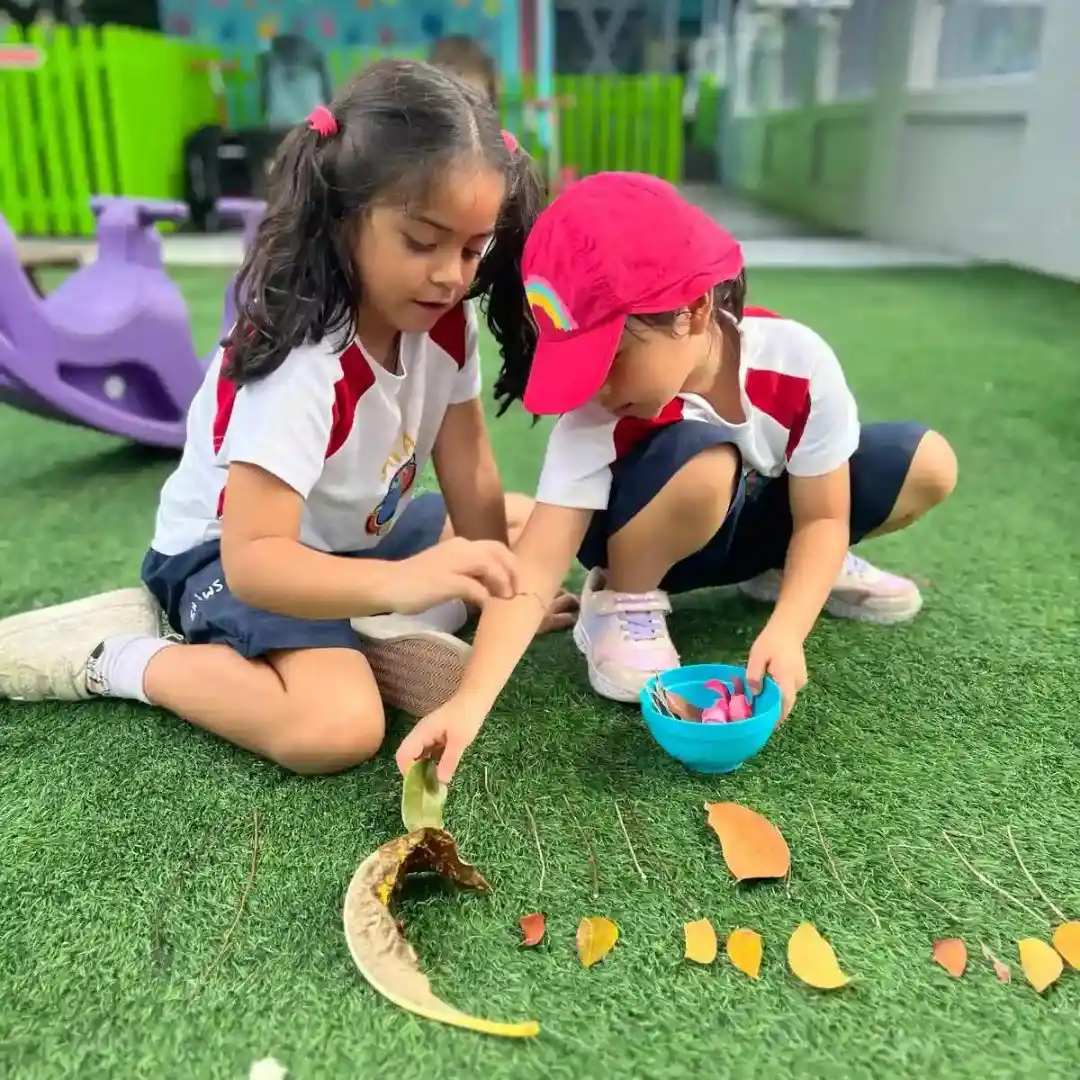
Play-based learning is an approach where children lead the activity and the adult designs the conditions. Rather than being told a fact and asked to repeat it, a child is given materials, a question and enough freedom to work something out.
The teacher is far from passive. Behind every apparently spontaneous activity there is a learning objective, a set of prepared materials and an adult watching closely for the moment to ask the next question. The skill is in knowing when to step in and when to stay out of it.
Children remember what they discover. When a child works out for themselves that the tall thin container and the short wide one hold the same amount of water, that understanding is theirs — and it survives long after a memorised answer would have faded.
Play also happens to be the natural home of the skills that are hardest to teach directly: negotiating, waiting, recovering from a setback, persuading three other people that your plan is better.
Academic preschool programmes can produce impressive short-term results — children who can recognise more letters at four. The gap tends to close within the first years of primary school, and what remains is the difference in attitude: whether a child regards a hard problem as interesting or as a threat.
This isn’t an argument against academics. Shaws children learn phonics, number and writing on a deliberate progression. The difference is the route we take to get there.
Prepared environments, educational materials and group activities. Children move between stations rather than sitting through a lesson.
Gardens, playgrounds, sandpits and sports fields — where physical confidence and social negotiation are learned in earnest.
Experiments, builds and practical tasks that run across days or weeks, with genuine outcomes children care about.
Plenty of schools use the phrase. Here’s what to look for on a tour.
In a genuine play-based room, several different things are happening at once and children are making decisions about what they do next. If everyone is doing the same activity at the same time, it isn’t play-based — it’s a lesson with toys.
Ask for the actual timetable, not the philosophy. Outdoor time should appear several times a day, not once as a break.
Watch a teacher’s reaction. In a play-based setting, a wrong answer is the beginning of the interesting part — not something to be corrected and moved past.
A spotless classroom in the middle of the morning is a warning sign. Sand, paint and water should be in use, not on display.
Ask what today’s activity is teaching. A good play-based school has a clear, specific answer — and can tell you where it sits in the progression.
Book a weekday tour and see for yourself what a room full of children genuinely absorbed in something looks like.