Quick answer: simple board games teach young children to wait for a turn, follow rules, count, recognise colours and, eventually, lose without the evening ending in tears. Start around three with short games based on luck rather than strategy, play cooperatively as well as competitively, and let the child lose sometimes. The learning is in the playing, not the winning.
There is a moment in many families when a box with a spinner comes out for the first time. The rules are explained, the pieces are chosen with great seriousness, and within four minutes someone has flipped the board.
That is fine. That is where the lesson starts.
What a board game really teaches
Taking turns. A board game makes waiting visible. The dice goes round, and the child can see exactly when it will be theirs. For a three-year-old, sitting through two other turns is real work.
Following rules. Games have rules that everyone agrees to, and that do not change because someone is unhappy. That is a gentle introduction to how most of school, and most of life, works.
Counting and number sense. Moving a piece four spaces means counting four objects in a line, one by one, which is exactly how early number understanding is built. Many children can recite numbers long before they can do this reliably.
Colours, shapes and matching. Many first games are built around them.
Paying attention. Remembering whose turn it is and where your piece was.
Losing. The big one, and the reason it is worth persisting.
Choosing a first game, by type
There is no need to chase a particular brand. Think about the type of game instead.
Roll and move games. Throw a dice, move along a track. Pure luck, which is ideal, because a young child can beat an adult fairly and nobody needs strategy.
Matching and memory games. Turning over cards to find pairs. Preschoolers are often better at these than their parents, which does wonders for morale.
Cooperative games. Everyone plays together against the game, perhaps to get all the animals home before the storm. Nobody loses to anybody, which makes these excellent for younger or more sensitive children.
Simple colour and shape games. Spin a colour, find a match.
Dexterity games. Stacking, balancing and fishing games that practise fine motor control and patience.
A few things to look for on the box, whatever the type:
- Play time of fifteen minutes or less.
- Few rules, ideally explainable in a sentence or two.
- Large, sturdy pieces, and nothing small enough to be a choking hazard for younger siblings.
- No reading required.
Save strategy games for later. A four-year-old who loses because an adult planned three moves ahead has learned nothing except that games are unfair.
How to play so it actually works
Keep it short. Stop while it is still fun, even mid-game. A half-finished game is better than a ruined one.
Simplify the rules. Drop the complicated bits. You can add them back in a year.
Let them count. Even when it is slow. Especially when it is slow.
Narrate the turns. "It is Daddy's turn, then Grandma's, then yours." It makes the waiting feel shorter and predictable.
Do not always let them win. This is the hard one. If a child only ever wins, they never practise the more useful skill. In luck-based games you do not need to do anything at all: the dice will sort it out.
Do not cheat to lose, either. Children notice, and it quietly suggests that losing is so bad it has to be avoided.
The child who has to win
Nearly every preschooler finds losing hard at first. Tears, protests and sudden rule changes are normal around three and four.
What helps:
- Say what you expect before you start. "Someone will win and someone will not. Then we can play again."
- Show them how to lose. When you lose, say it out loud: "Oh, I did not win. That is a bit disappointing. Well done. Shall we play again?" Children learn more from watching you lose than from any lecture.
- Name the feeling. "You really wanted to win. That is frustrating."
- Keep the tone light. No gloating from anyone, including older siblings.
- Play cooperative games when losing is too raw. Then return to competitive ones later.
- Praise how they played. "You waited so patiently for your turn" is worth more than the result.
If the board goes flying, calmly put the game away and try again another day. No big speech is needed.
Why it is worth the effort
Screens are designed to keep a child engaged on their own. A board game does the opposite: it needs other people, patience and conversation. It puts parent and child at the same table, looking at the same thing, taking turns being in charge of the dice.
What this looks like at Shaws
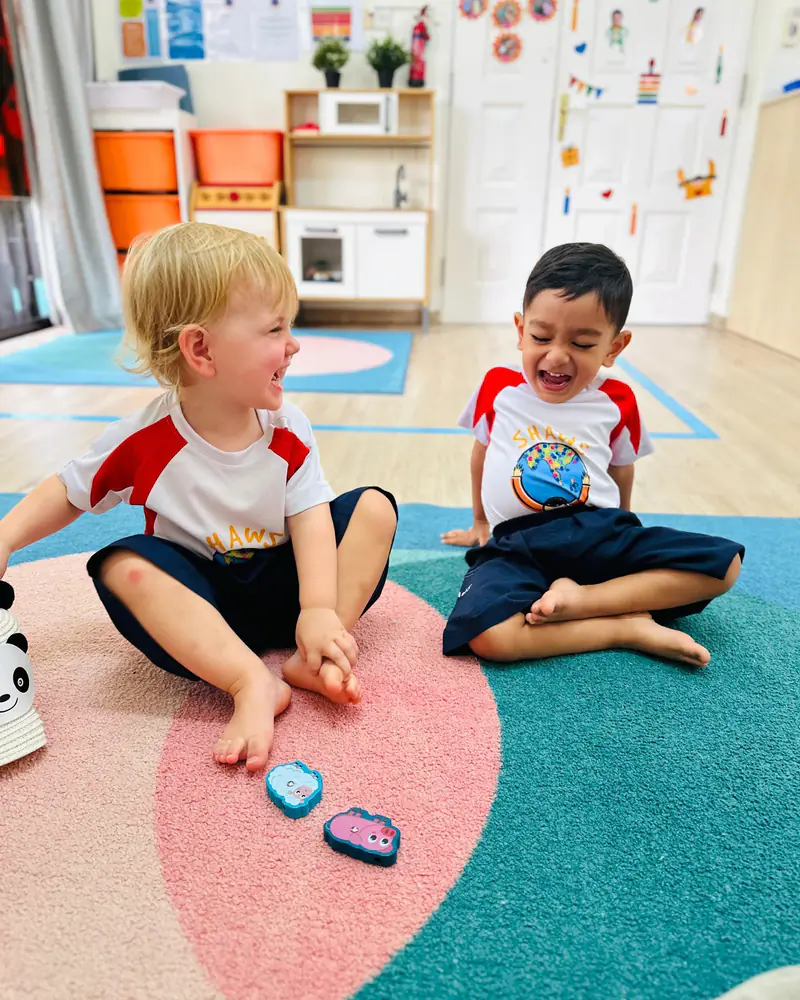
Simple table games are part of ordinary play in our rooms, alongside blocks, puzzles and role play. Teachers sit in, keep turns moving and help children through the tricky bit at the end, when someone wins and someone does not. Over a year, you can watch a child who cried at every loss become the one saying "good game" first.
A game worth playing badly
You do not need the perfect game or a quiet, patient evening. You need fifteen minutes, a dice and a willingness to lose cheerfully in front of a very small, very competitive person.
Shaws Preschool has been teaching children to take turns and lose gracefully across the East Coast and Serangoon since 1989. Come and see a morning of play: book a tour.