Quick answer: risky play, such as climbing, balancing, jumping and rough and tumble, teaches children to judge risk, handle fear and understand what their bodies can do. The key is telling a risk (a challenge a child can see and choose) from a hazard (a danger they cannot see or manage). Remove the hazards, allow the risks, and swap "be careful" for words that help a child think.
Stand in any playground for ten minutes and you will hear it a dozen times. Be careful. Get down. That is too high.
The instinct is completely natural. Nobody wants a trip to the clinic. But researchers and experienced early years teachers increasingly agree that a child who is allowed to take small risks becomes a child who is better at avoiding big ones.
What risky play is
Risky play is thrilling, uncertain play where a small injury is a real possibility. It usually includes:
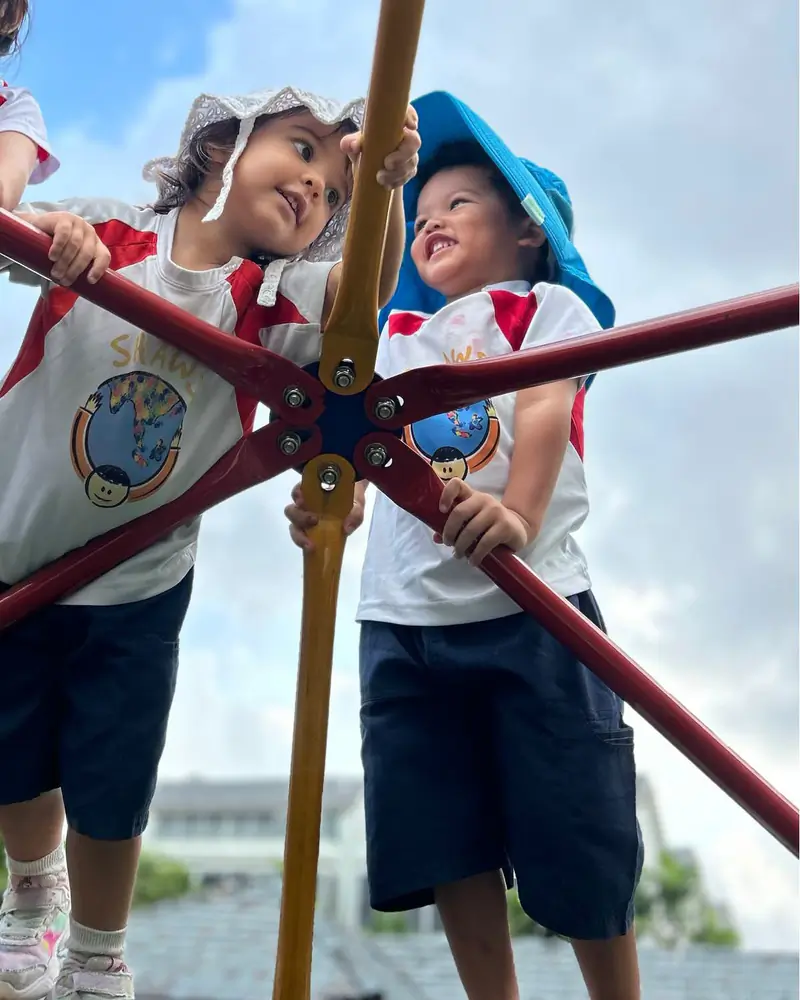
- Heights: climbing frames, trees and rocks.
- Speed: running flat out, slides, swings, scooters.
- Balance: walls, logs and beams.
- Rough and tumble: chasing, wrestling, play fighting.
- Real tools, suited to their age and closely supervised.
- Exploring: going a little out of sight and finding their own way back.
Risk is not the same as hazard
This is the distinction that makes risky play workable.
A risk is a challenge the child can see and make a decision about. A high branch. A wobbly log. A big jump. They can judge it, try it or back away.
A hazard is a danger the child cannot see or cannot reasonably manage. A rotten branch. A broken slat. A nail sticking out. A road at the bottom of the slope. Water with no adult nearby.
The adult's job is to remove the hazards and leave the risks. Check the equipment, look at what is underneath, and then let the child get on with it.
Why it makes children safer
They learn their limits. A child who climbs regularly learns how high feels right, how strong their grip is and how to get down again. A child who has never been allowed up has no way of knowing.
They build physical competence. Strength, balance, coordination and body awareness are what prevent falls, and they are built by doing, including the occasional slip.
They practise managing fear. Standing at the top, feeling scared and deciding what to do next is a genuine emotional skill.
They learn from small consequences. A grazed knee teaches more about paying attention than a hundred warnings, at a far lower cost than a serious fall later on.
They build confidence. Managing something that felt hard produces a kind of self-belief that praise cannot.
Children kept away from all risk can end up anxious about perfectly manageable challenges, or careless because they have never learned what danger feels like.
What to say instead of "be careful"
"Be careful" is vague. It tells a child you are worried, but not what to pay attention to. Try something that helps them think instead:
- "Do you feel steady?"
- "Where will you put your foot next?"
- "Check that branch before you hold it."
- "What is your plan for getting down?"
- "Take your time."
- "Is that rock slippery?"
- "Is there space for you to land?"
- "I am right here if you need me."
And sometimes the most useful thing to say is nothing at all.
Some simple rules of thumb
- Do not lift children onto things. If they cannot climb up on their own, they usually cannot climb down safely either.
- Stay close, hands off. Near enough to help, far enough that they are doing it.
- Let them stop. A child who decides it is too high has made a good decision. Never push them further.
- Match the challenge to the child. A two-year-old and a five-year-old need very different levels.
- Deal with the hazards. Broken equipment, hard ground under high drops, traffic and water.
- Helmets for wheels, not for climbing. Scooters and bikes need one. On climbing frames the straps can catch, so take it off.
- Watch your face. Children read panic instantly, and a calm expression does a great deal.
Managing your own nerves
For many parents, the hardest part of risky play is watching it. Breathe, glance away for a moment if you must, and remember that a bruise heals quickly while a habit of fear can linger. Most children are far more cautious than we give them credit for.
What this looks like at Shaws
Our outdoor play includes climbing, balancing, running and plenty of physical challenge, with teachers who check the space first and then step back. We talk with children about how to manage a risk rather than simply telling them to stop, and we notice out loud when they make a good decision, including the decision to come down.
When to seek advice
Bumps and grazes are part of play. See a doctor for any head injury followed by vomiting, drowsiness, confusion or unusual behaviour, for a limb that looks misshapen or that your child will not use, or for any injury that worries you.
It is also worth mentioning to your doctor if your child seems unusually clumsy, falls far more often than other children their age, or is very fearful of all physical play.
The long view
The children who grow into careful, capable teenagers are rarely the ones who were never allowed on the climbing frame. They are the ones who spent years working out, one branch at a time, exactly what they could manage.
Shaws Preschool has let children climb, balance and test their limits outdoors across the East Coast and Serangoon since 1989. Come and see our outdoor spaces: book a tour.