
Quick answer: young children can and should play outdoors here every day. The trick is timing rather than duration: go early or late, stay in shade, keep water going in constantly, add water play, and watch the child rather than the thermometer. Children overheat faster than adults and are much worse at noticing it.
Singapore makes indoor life very easy. Air conditioning, malls, indoor play centres and a two o'clock sun that feels like a wall. It takes real intent to get a four-year-old outside, and plenty of families quietly stop trying.
The cost of that is bigger than it looks, so it is worth solving rather than accepting.
Why outdoor time is not optional
- Physical development. Running, climbing, jumping and balancing need space that a flat cannot provide. These are the years when those patterns are laid down.
- Eyes. Time outdoors in daylight is associated with lower rates of short-sightedness in children, which matters a great deal in this part of the world.
- Sleep. Daylight exposure, especially in the morning, helps set a child's body clock. Outdoor children sleep better, and so do their parents.
- Mood and behaviour. A great deal of what looks like difficult behaviour is a child who has not moved enough.
- Risk and judgement. Climbing something slightly too high is how a child calibrates what their body can do. It cannot be learned from a chair.
Timing beats everything
The single most useful change is when you go, not how long you stay.
Early morning is the best window. Before about ten, it is bearable, the light is good and playgrounds are empty. If your family can build a short morning outdoor habit, everything else gets easier.
Late afternoon works too. After around half past four the ground has usually cooled enough that equipment is not too hot to touch.
Midday is for water or shade. Between eleven and four, choose a shaded park, a covered void deck, a wooded trail or a paddling pool rather than an exposed playground.
Practical heat management
- Water, constantly. Young children do not reliably feel thirsty until they are already behind. Offer drinks every fifteen to twenty minutes rather than waiting to be asked, and take more than you think.
- Dress for it. Light, loose, light-coloured, quick-drying. A wide-brimmed hat does more than a cap.
- Sun protection. Shade first, clothing second, sunscreen for what is left uncovered. Reapply after water play.
- Check the equipment. Metal slides and dark rubber surfaces get genuinely hot. Touch it with your own hand before your child does.
- Build in shade breaks. Ten minutes running, a few minutes in the shade with a drink. Children will not pace themselves, so you have to.
- Add water. A paddling pool, a hose, a water table or a splash playground changes the entire calculation. Children will happily stay out for an hour if there is water involved.
What to watch for
Children overheat faster than adults, sweat less efficiently, and are far less likely to say anything about it. Watch the child, not the clock.
Signs to take seriously: a very flushed face, unusual crankiness or whining, a child suddenly going quiet or floppy, complaining of a headache or tummy ache, skin that is hot and dry, or a child who stops sweating in the heat.
If you see these, move into shade or air conditioning, offer cool drinks, loosen or remove extra clothing, and cool the skin with a wet cloth. If a child seems confused, is vomiting or does not improve, get medical help promptly. Never leave a child in a parked car, not even for a minute.
Rain, haze and the rest
Rain. Warm rain is not dangerous and children love it. If there is no thunder, a wet playground and a change of clothes in a bag makes for one of the best mornings of the week. Come inside for thunder, without exception.
Haze. On days when air quality is poor, follow the official readings and move indoors. Have a small indoor movement plan ready so the day does not collapse into screens: an obstacle course of cushions, balloon games, dancing, animal walks down the corridor.
Where to go
Singapore is unusually well supplied. Shaded neighbourhood playgrounds, the park connectors, the beaches at East Coast, the nature reserves for older preschoolers, the free splash playgrounds around the island, and the void deck at the bottom of the block, which is genuinely underrated on a hot day.
You do not need a destination. Twenty minutes downstairs counts.
How we handle it
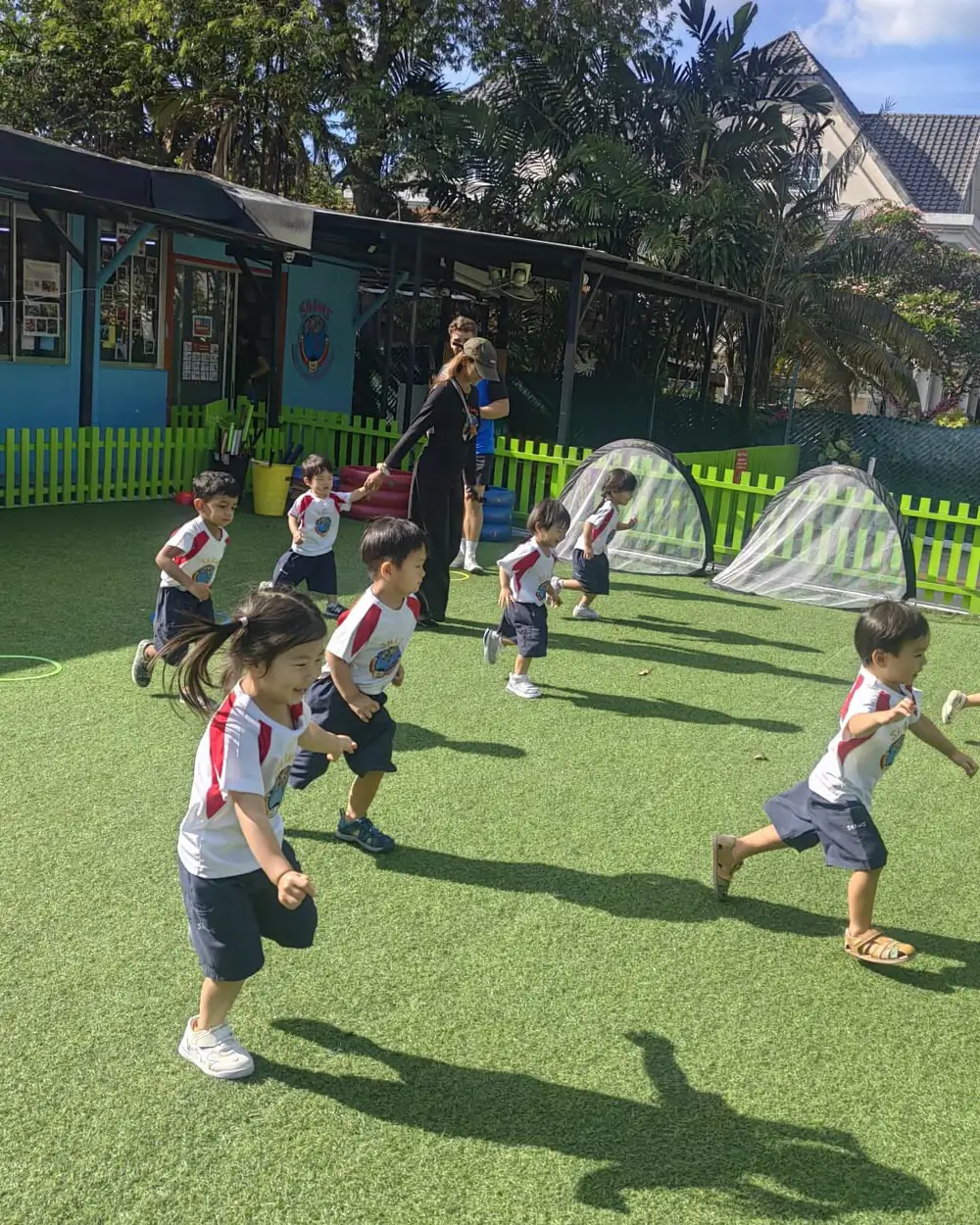
Our children go outside every day. We simply arrange the day around the heat: outdoor sport and free play in the morning when it is coolest, water play as a regular part of the week, shaded areas, and hydration built into the routine rather than left to chance. Our teachers are watching for the flushed cheeks and the sudden quiet long before a child would think to mention it.
Children who spend their preschool years outdoors, in this climate, learn something useful. They learn that heat is a thing you plan around, not a reason to stay in. That habit is worth passing on.
Shaws Preschool has kept children outdoors and moving across the East Coast and Serangoon since 1989, with daily sport and outdoor learning built into every morning. Come and see: book a tour.