Quick answer: number sense is a child's feel for what numbers mean, and it grows fastest through talk and hands-on experience, not worksheets. Count real things, compare sizes and amounts, notice shapes and patterns, and ask "how do you know?" during everyday routines. A few minutes of this spread through the day does more than a workbook ever will.
Most parents can tell you whether their child can count to twenty. Fewer can tell you whether their child knows that twenty is more than twelve, or that five sweets are still five sweets after you spread them out.
That second kind of knowledge is the one that matters. It is the foundation that later maths is built on, and it is almost entirely learned away from a desk.
What number sense actually is
Reciting numbers is a song. Number sense is understanding. It includes a few quiet milestones:
- One-to-one correspondence. Touching each object once, and saying one number for each. Young children often count faster than they point, and that is normal.
- Knowing the last number is the total. A child who counts four cars and then says "four" when asked how many has understood something important.
- Seeing small amounts at a glance. Recognising three dots without counting them, the way you read the face of a dice.
- Comparing. More, fewer, the same. Longer, shorter, heavier, lighter.
- Understanding that amounts can be split and combined. Five is three and two, and also four and one.
None of these arrive on a schedule, and none of them are helped by pressure.
Why worksheets come too early
A worksheet asks a child to work with symbols on paper before they have a solid sense of what the symbols stand for. Some children can do it, in the way a child can learn to sing a song in a language they do not speak.
Maths teaching in Singapore's primary schools is well known for moving from concrete objects, to pictures, to abstract symbols, in that order. Preschool is the concrete stage. Children need to handle, move, sort and share real things, many times over, before the numbers on the page mean much at all.
The maths hiding in your day
Breakfast. How many slices of apple are there? If you eat one, how many are left? Who has more?
Setting the table. One plate for each person is one-to-one correspondence in its purest form. If a guest is coming, how many more do we need?
The lift. Which floor are we going to? Is that higher or lower than Grandma's? Let them press the button and read the number.
The stairs. Count them going up. Count backwards coming down, which is harder and very satisfying.
The laundry. Pairing socks is matching. Sorting by colour or by owner is classifying. Folding a towel in half, and then in half again, is early fractions.
The supermarket. Put six oranges in the bag. Which bottle is heavier? Is the big box always the one with more inside?
The bath. Which cup holds more water? How many small cups fill the big one?
Waiting. Spotting shapes on a hawker centre table, counting red cars from the bus stop, noticing the pattern in floor tiles while the queue shuffles forward.
Words that do the heavy lifting
A great deal of early maths is vocabulary. Children cannot compare what they cannot name. Use these words freely and precisely:
- more, fewer, less, the same, equal
- bigger, smaller, taller, shorter, longer, wider
- heavier, lighter, full, empty, half
- first, next, last, before, after, between
- above, below, behind, in front of, inside
Research on early language suggests that children who hear more of this kind of talk tend to arrive at school with a firmer grasp of number and space. It costs nothing, and it fits into sentences you were going to say anyway.
Shapes and patterns
Shapes are everywhere once you look. Round clock, rectangle door, triangle roof on a drawing. Go beyond naming: how many corners does it have? What happens if you put two triangles together?
Patterns are early algebra. Red, blue, red, blue. Clap, stamp, clap, stamp. Ask what comes next, then let your child invent one for you to continue, and make a deliberate mistake now and then so they can catch it.
How to talk without testing
The difference between maths talk and a quiz is tone. "How many are there?" fired at a child who is busy playing feels like an exam. "I wonder if there are enough cups for everyone" invites them in.
Think out loud. "I have three, and Daddy wants two more. Let me see, four, five."
Ask how, not just what. "How did you work that out?" is more valuable than confirming the answer.
Welcome wrong answers. "Let's check together" keeps them willing to have a go next time.
Stop while it is fun. Two or three questions is plenty.
What this looks like at Shaws
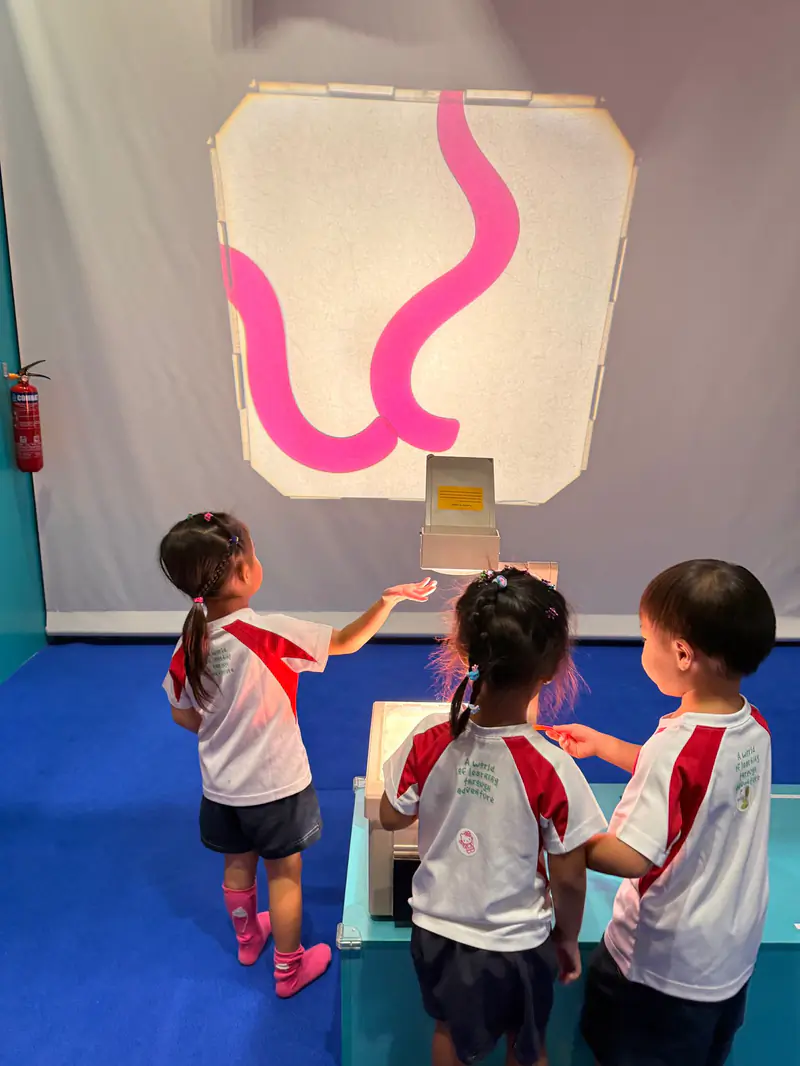
In a play-based room, maths turns up in the blocks corner, the sand tray, the water table and the pretend shop. Teachers notice when a child is lining up animals or sharing out playdough, and add the right question at the right moment: do we have enough, which tower is taller, how could we make it fair.
Children who have spent their preschool years talking about amounts and shapes tend to meet written maths in Primary 1 as a new way of writing something they already understand. That is a far better starting point than a stack of completed worksheets.
Shaws Preschool has been building early maths through blocks, sand, songs and conversation across the East Coast and Serangoon since 1989. Come and count the cups with us: book a tour.