Quick answer: most children learn to read by linking the sounds they hear in spoken words with the letters that stand for them, then blending those sounds together. That is phonics. It starts long before a child opens a reading book with rhymes and listening games. It works best when it is playful and unhurried.
Ask a parent how their child is getting on with reading and you will often hear about the alphabet. Can she sing her ABCs? Does he know his letters? Letter names are nice to know, but on their own they do surprisingly little for reading. A child who knows that a letter is called "bee" still has to learn that it makes a "b" sound before they can read the word "bat". That link between letters and sounds is what phonics teaches.
What phonics involves
Phonics is a way of teaching reading by matching sounds to letters or groups of letters. English has more sounds than it has letters, so some sounds are written with two letters, like "sh" in ship.
Children gradually learn:
- Letter sounds. That "s" says "sss" and "m" says "mmm".
- Blending. Pushing sounds together to read a word, so c-a-t becomes "cat".
- Segmenting. Breaking a spoken word into its sounds in order to spell it, so "dog" becomes d-o-g.
- Digraphs and blends. Letter pairs that make one sound, like "sh", and consonants that sit side by side, like "st" in stop.
It starts with listening
Before children connect sounds to letters, they need to hear the sounds inside words. Teachers call this phonological awareness. It develops through talk and songs long before formal reading begins, and you can build it with no materials at all.
- Rhyme. Nursery rhymes and silly rhyming games. "What rhymes with cat? Hat, mat... zat!" Nonsense rhymes count.
- Clapping syllables. Clap out names. "Ra-chel" is two claps, and "Al-ex-an-der" is four.
- I spy with sounds. "I spy something beginning with mmm." Use the sound instead of the letter name.
- First-sound games. "Mummy and milk both start with mmm. What else does?"
- Stretchy words. Say a word slowly, stretching each sound out: "sssuuunnn".
Children who enjoy these games are building exactly the skills they will need when letters come along.
Sounds before names
When you start to introduce letters, focus on their sounds more than their names. Say each sound as cleanly as you can, without adding an "uh" on the end. "S" is "sss", and "m" is "mmm". Clean sounds make blending much easier later, because "c-a-t" runs together into "cat" in a way that "cuh-a-tuh" never quite does.
Lowercase letters are more useful than capitals at first, since most of the words children meet in books are written in lowercase.
Why characters and stories help
Young children remember stories far better than abstract symbols. That is the thinking behind programmes such as Letterland, which turns each letter into a character whose name starts with its sound. Annie Apple stands for the short "a" sound. Clever Cat stands for the "c" sound. Children remember the characters long after a flashcard would have been forgotten, and the stories give them a reason to care which letter is which.
At Shaws, children from 18 months to three learn letters and their sounds through Letterland, along with plenty of rhymes and games. Between three and five they move on to word families and consonant blends, and they begin creative writing. By five to six they are reading at a higher level and writing short compositions. Our progressive English classes are designed to take children to confident reading and writing by K2.
Simple phonics at home
You do not need to teach reading formally at home. A few minutes of play a few times a week is plenty for a preschooler.
- Read aloud every day. Being read to builds vocabulary and a love of stories, and both of those underpin reading.
- Spot letters out and about. Point out the first letter of your child's name on a sign at the MRT station or on a cereal box at the supermarket.
- Play sound games while you wait. I spy and first-sound games fill a queue at the clinic very nicely.
- Use magnetic letters. Build short words like "cat" on the fridge. Say each sound slowly before blending them into the word, then swap one letter to make "hat".
- Write together. Let your child "write" the shopping list. Say the sounds aloud as you write words for them, and welcome their invented spellings.
- Follow their interests. A child who loves dinosaurs will happily hunt for the "d" sound all afternoon.
Signs your child is ready for more
Children come to reading at different ages. Signs that your child might be ready for a little more include:
- Noticing rhymes and enjoying rhyming games.
- Hearing the first sound in a word.
- Recognising some letters, especially the ones in their own name.
- Asking what signs and labels say.
- Pretending to read by turning pages and telling the story from the pictures.
If your child is not showing these yet, that is fine. Keep reading together and playing with sounds. Pushing reading on a child who is not ready can turn it into a chore, which is the opposite of what you want.
Common worries
"My friend's child is reading at four and mine isn't." Children learn to read across a wide range of ages. A child who loves books and stories is in a strong position whenever reading clicks for them.
"Should I buy phonics workbooks?" Games and conversation tend to work better than worksheets at this age. If your child enjoys tracing letters, there is no harm in it, but it is not required.
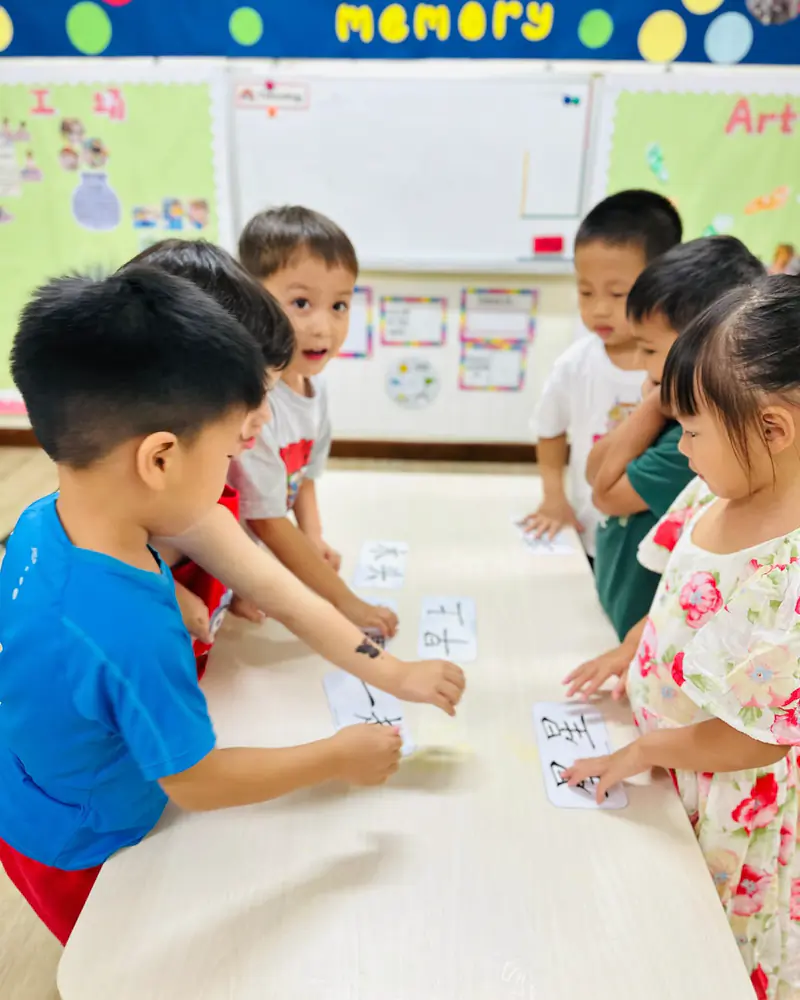
"What about Chinese?" Reading Chinese means learning to recognise characters, which works differently from English phonics. Children at Shaws learn Mandarin every day alongside English, so they build both skills side by side.
"When should I worry?" If your child still finds it hard to hear rhymes or first sounds by the end of K1, or struggles to remember letter sounds after plenty of practice, talk to your child's teacher. A family history of reading difficulties is worth mentioning too. If you have any concerns about hearing or speech, see your paediatrician.
Learning to read at Shaws
At Shaws, literacy is played as a game instead of drilled. Letterland and literacy sessions are part of the weekly timetable. Daily Mandarin sits alongside them. Stories and songs run through the rest of the day. You can read more about how literacy fits into our ShawsPlay curriculum. If you would like to watch a phonics session for yourself, book a tour on a weekday morning, or send us an enquiry with any questions about how we teach reading.