Quick answer: ball skills build hand-eye coordination, timing, spatial judgement and physical confidence, and children who learn them before six tend to stay active for years afterwards. They are learned through hundreds of relaxed repetitions, not lessons, and a rolled-up sock in a corridor is a perfectly good start.
Ask a parent what they hope their child gets from preschool and sport is rarely first on the list. Ask a Primary 1 teacher which children settle fastest, and physical confidence comes up surprisingly often.
The two are connected, and the connection runs through some fairly ordinary skills.
What a ball is actually teaching
Throwing and catching look simple because adults have automated them. For a four-year-old, a catch requires a remarkable set of jobs done at once:
- Tracking. Following a moving object with the eyes, which is the same visual skill that later follows a line of text across a page.
- Prediction. Working out where something will be, not where it is. That is genuine spatial reasoning.
- Timing. Closing the hands at the right moment, which is coordination between what the eyes see and what the body does.
- Crossing the midline. Reaching across the body, which supports the two sides of the brain working together.
- Force control. Learning how hard to throw, which is judgement rather than strength.
None of this can be explained. All of it is learned by doing it badly a few hundred times, then slightly less badly.
The confidence part
There is a second effect that matters just as much. A child who can join in a ball game joins in. A child who cannot tends to drift to the edge of the playground, and by seven or eight that drift has become a settled opinion: I am not sporty.
That opinion is very sticky, and it arrives far earlier than most parents expect. Building basic competence before six is the simplest way to keep the door open, whether or not your child ever plays a sport seriously.
Roughly what to expect, by age
- 2 years: rolling a ball, throwing underarm with no direction to speak of, kicking by walking into it. Catching is mostly a hopeful hug.
- 3 years: throwing overarm, catching a large ball against the body, kicking a stationary ball forward on purpose.
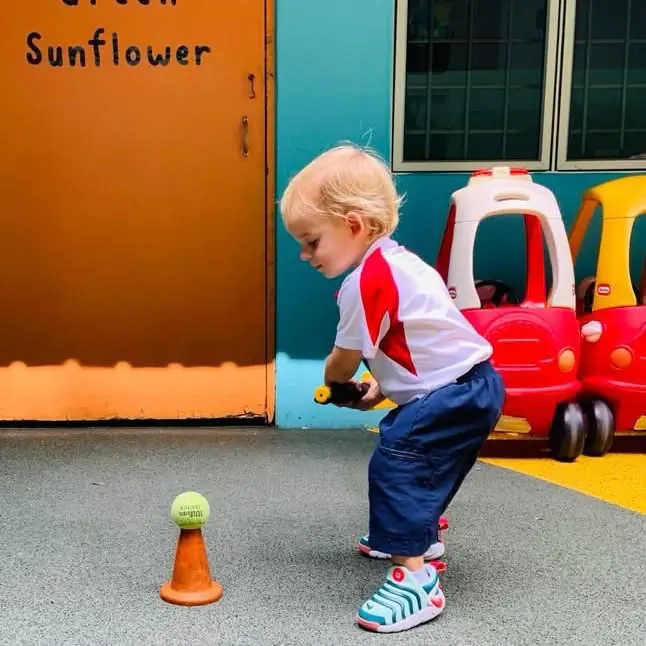
- 4 years: catching a bounced ball with hands, throwing with some aim, kicking while moving, hitting a ball off a tee.
- 5 to 6 years: catching a thrown ball reliably, throwing with a step and a turn, dribbling a ball with the feet, and starting to enjoy simple games with rules.
Children vary enormously and late is not a problem. What matters is that they keep having a go.
Games that work in a flat or a void deck
You do not need a field. You need a soft ball and ten minutes.
- Sock ball. Roll a pair of socks into a ball. Safe indoors, easy to catch, impossible to break anything with.
- Balloon keepy-uppy. A balloon moves slowly, which gives a young child time to track and react. It is the single best catching trainer for a three-year-old.
- Washing basket basketball. Score into a basket, then step back one tile each time.
- Bounce and catch. Bouncing is easier than catching from the air, so start there.
- Roll the target. Set up a couple of empty bottles and roll a ball to knock them down. Bowling is a real aiming skill.
- Kick the corridor. A soft ball, two shoes as goalposts, a very short pitch.
- Beat the clock. How many catches in thirty seconds. Children this age will repeat something endlessly if it has a number attached.
How to coach without putting them off
Get closer. Most failed catches happen because the adult is standing too far away. Move in until they are succeeding most of the time, then move back a step.
Throw slower and higher. Give them time to track it. A gentle lob is far more useful than a fast accurate pass.
Aim for the chest. Hands out, arms slightly bent, ball to the middle. Then let them work it out.
Say what went right. "Your hands were ready that time." Specific, factual, no praise inflation.
Stop while it is still fun. Ten cheerful minutes today beats forty minutes that ended in frustration.
Do not correct technique much. Under six, the goal is repetitions and enjoyment. Refinement comes later and comes easily once the confidence is there.
Why sport is in our day, every day
Shaws has daily sport for every age group, not a weekly session. Our coaches work with children from the youngest room upwards on the basics: running, throwing, catching, kicking, balancing, striking off a tee.
We do it partly because children need to move, in a country where indoor life is easy and afternoons are hot. But the bigger reason is what it does to a child's sense of themselves. A five-year-old who knows they can catch walks into a new group of children differently. That confidence spreads into the classroom, into making friends, into trying the thing they are not yet good at.
A ball is a small piece of equipment. What it builds is not small at all.
Shaws Preschool has run daily sport alongside play-based learning across the East Coast and Serangoon since 1989, with our own coaches and an annual sports carnival. Come and watch a session: book a tour.