Quick answer: you do not have to speak Mandarin to raise a child who is comfortable in it. What a preschooler needs from you is exposure, warmth and the clear message that this language is enjoyable and normal. Accuracy is the school's job. Attitude is yours, and attitude is the part that lasts.
This is one of the most common worries we hear from parents at tours. It usually arrives quietly, near the end: "We speak English at home. Both of us. Will she be behind?"
The short version is no, and here is why.
What actually predicts second-language success before six
Not vocabulary drills. Not flashcards. Three things, consistently:
- Volume of meaningful exposure. Hours in which the language is being used to do something real, not being studied.
- Emotional association. Whether the language feels like fun, songs and warm adults, or like a test.
- Willingness to make mistakes. A child who will happily say the wrong word out loud learns twice as fast as one who freezes.
Notice that none of the three requires you to be fluent. In fact, a parent who is anxious about their own Mandarin can accidentally undermine all three by treating the language as a problem to be solved.
The single most useful thing you can do
Never say "I am terrible at Chinese" in front of your child. Not as a joke, not as an apology to the teacher.
Children absorb our attitudes far faster than our grammar. A child who hears a parent describe a language as hard, or as something our family is not good at, has been handed a story about themselves before they have started. Replace it with something true and warmer: "This one is new for me too. You will get ahead of me soon."
Now they are the expert, and four-year-olds love being the expert.
Practical things that work in a non-Mandarin household
- Let songs do the heavy lifting. Music carries tone, rhythm and vocabulary in a package a preschooler will happily repeat two hundred times. Play the same handful of Mandarin songs in the car until you know them too.
- Pick five phrases and mean them. Not lessons. Real moments. A greeting at pick-up, a phrase at bath time, one at dinner, one at bedtime, one for shoes on at the door. Five phrases used daily beat fifty words practised occasionally.
- Ask your child to teach you. "What did Laoshi call this today?" This does three jobs at once: it revises the word, it signals that you value the language, and it puts the child in charge.
- Use the city. Singapore is an enormous free classroom. Order at the hawker centre. Read the signs on the MRT. Ask your child what the characters on the shop front might mean and let them guess wildly.
- Read aloud in both, without translating every line. Children tolerate not understanding every word far better than adults do. Let the pictures and your voice carry the meaning.
- Involve the wider family. If a grandparent, an aunt or a helper speaks Mandarin, ask them to speak it with your child rather than switching to English for your benefit. Family conversation is the richest input there is.
What not to worry about
Mixing languages. A three-year-old who puts a Mandarin word in the middle of an English sentence is not confused. They are doing what every bilingual person does: reaching for the best word available. It sorts itself out.
A quiet period. Children learning a second language often understand long before they produce. A child who says nothing in Mandarin for months may be absorbing steadily, then arrive home one day with a full sentence.
Being slightly behind a classmate whose family speaks it at home. Of course they are ahead. They have thousands more hours. Compare your child to your child six months ago.
What good preschool bilingualism looks like
Ask this question on your next school tour: is Mandarin a subject here, or a language the day happens in?
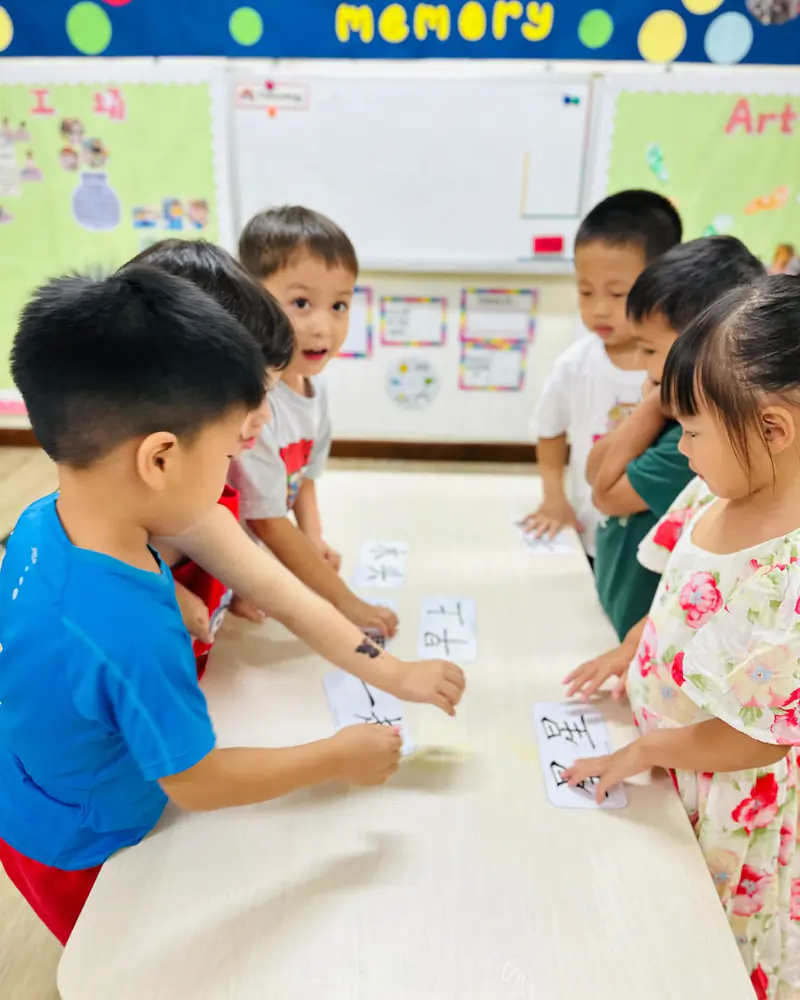
The difference matters enormously. In the first version, children have Chinese class, then go back to English. In the second, a Mandarin-speaking teacher is in the room during play, snack, story and outdoor time, using the language for real purposes: pass me that, whose turn is it, look at what you built. That is how children pick up a language rather than study one.
At Shaws, both languages live inside the day. Our Chinese teachers are part of play, not visitors to it, and the vocabulary children take home tends to be the vocabulary of things they were doing, which is precisely the vocabulary that sticks.
The long view
Your goal for a preschooler is not fluency. It is that when your child walks into Primary 1 Chinese, they feel like someone who already belongs in that language: they have sung in it, been comforted in it, played in it and laughed in it. That child will learn the characters. The child who has learned that Chinese is the hard subject the family is bad at has a much steeper hill, no matter how many words they memorised at four.
Warmth first. Exposure second. Accuracy will follow.
Shaws Preschool teaches in English and Mandarin across the East Coast and Serangoon, with both languages woven through play, sport and daily routines rather than taught as separate lessons. Come and hear it in action: book a tour.