Quick answer: children prefer the box because it has no fixed purpose, so their imagination gets to do the work. Open-ended materials, known as loose parts, produce longer, more inventive and more social play than finished toys. They are mostly free, and most of them are already in your recycling.
It is a scene so common it has become a joke. The carefully chosen present is opened, examined, and set aside within four minutes. The child then spends the rest of the afternoon inside the box it came in.
Parents laugh about this and then quietly buy another toy. It is worth taking the box seriously instead, because your child is telling you something specific about how play works.
The rule behind it
The more a toy does, the less the child does.
A finished toy has already made the decisions. A fire engine is a fire engine. It can be pushed around and it makes a siren noise, and after a few days the child has run out of things to discover, because there was only ever one idea in it.
A cardboard box has made no decisions at all. It is a boat, then a cave, then a shop counter, then a bed for the dog, then a rocket. Every one of those transformations is the child's own invention, and inventing is far more satisfying than operating.
What loose parts are
Loose parts is the term early years teachers use for materials that can be moved, combined, lined up, stacked, taken apart and repurposed without a right answer. Blocks are loose parts. So are shells, fabric scraps, bottle tops, cardboard tubes, pegs, string, cushions and sticks.
The defining features are simple: no fixed purpose, no instructions, no way to fail.
Why it produces better play
It is longer. Open-ended play sustains itself because the child keeps generating new problems to solve. A finished toy runs out.
It is more social. When materials have no set rules, children have to negotiate the rules with each other. That is where you hear the real work of a preschool room: no, that is the kitchen, you be the customer, we need a bigger one. Negotiation, persuasion, compromise and repair, all voluntary.
It builds thinking. A child working out how to make a bridge that does not collapse is doing engineering, at exactly the level their brain is ready for. They test, fail, adjust and retest without an adult setting a single task.
It suits every child in the room. A pile of blocks works for a two-year-old who is stacking and for a five-year-old who is constructing a city. Very few purchased toys have that range.
It is nearly free. This is not a small point. The best-resourced play corner in the country can be assembled out of things people throw away.
What to collect
Start a box and add to it over a few weeks:
- Cardboard in every size, from tubes to appliance boxes. Tubes are especially good with balls and cars.
- Containers and lids. Yoghurt pots, takeaway boxes, jars with the lids on.
- Bottle tops and buttons. Sorting, counting, patterning, and shop money.
- Fabric. Old sheets, scarves, tea towels. Capes, roofs, rivers, blankets, walls.
- Tape and string. The most requested materials in any preschool. Buy the cheap tape in bulk.
- Natural things. Shells from the beach, seed pods, smooth stones, leaves, sticks.
- Pegs and clips. For joining fabric to furniture, which is how a den gets built.
- Cushions and the sofa. The whole living room is a loose part if you let it be.
Keep it in one accessible container. If your child has to ask, the play will not start.
How to be useful without taking over
Do not demonstrate. The strongest instinct an adult has here is to show the child what to make. Resist it. Once you show them the right way, you have converted an open activity into a task with a correct answer.
Say what you see, not what you think. "You have made that one much taller" is more useful than "that is beautiful." It shows you were paying attention and invites them to keep going.
Ask questions when they are stuck. What could we use to hold it up? What happened when you tried the big one at the bottom?
Let them fail. The collapsing tower is the lesson. Rushing in to fix it removes the entire point.
Give them time. Loose parts play is slow to start. The first ten minutes can look like aimless fiddling. That is the setup, and interrupting it is why some parents conclude their child cannot play alone.
Tolerate the state of the room. Deep play looks like chaos from the doorway. Agree a tidy-up time and leave it alone until then.
What this looks like at Shaws
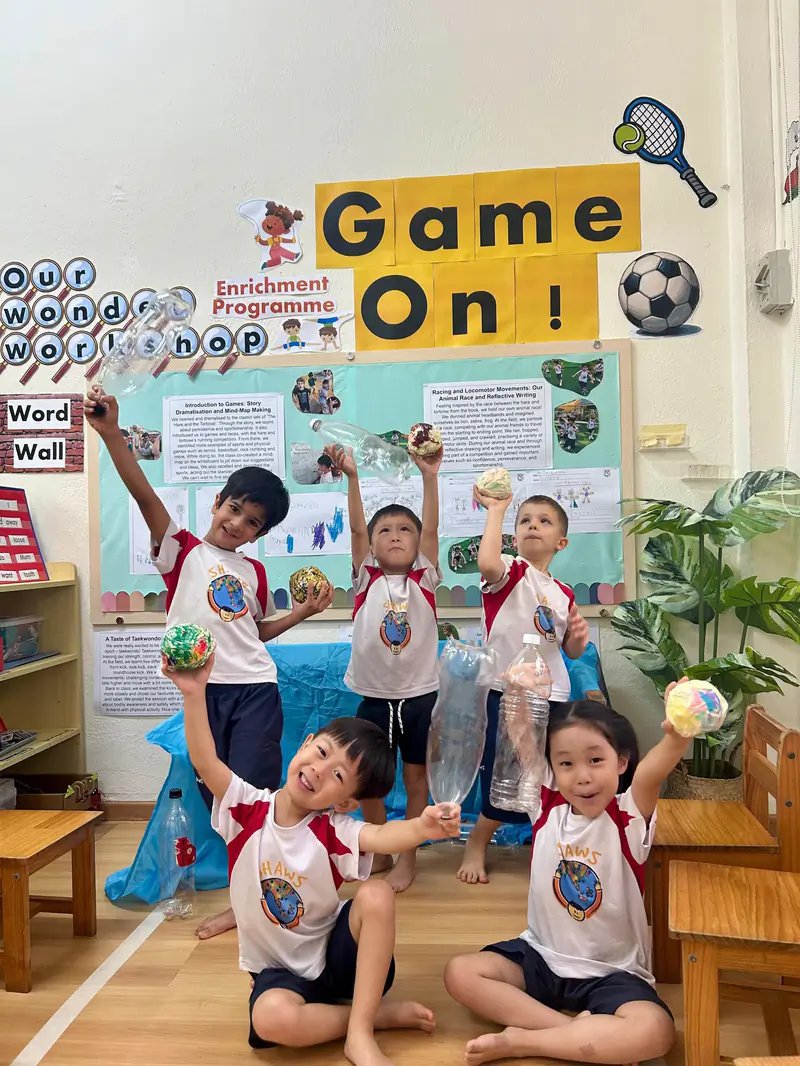
Our rooms are stocked with materials rather than products: blocks, fabric, tubes, boxes, natural objects, containers, and space to spread out. Teachers set the environment and then step back, watching for the moment when a question or an extra material moves a child on.
Children who have grown up playing this way arrive at Primary 1 able to start something on their own, stick with it, adapt when it goes wrong and work with someone whose idea is different from theirs. Those are not soft skills. They are the ones the rest of school runs on.
So keep the box. The toy was fine. The box is better.
Shaws Preschool has been building learning out of open-ended materials across the East Coast and Serangoon since 1989. Come and see a morning: book a tour.