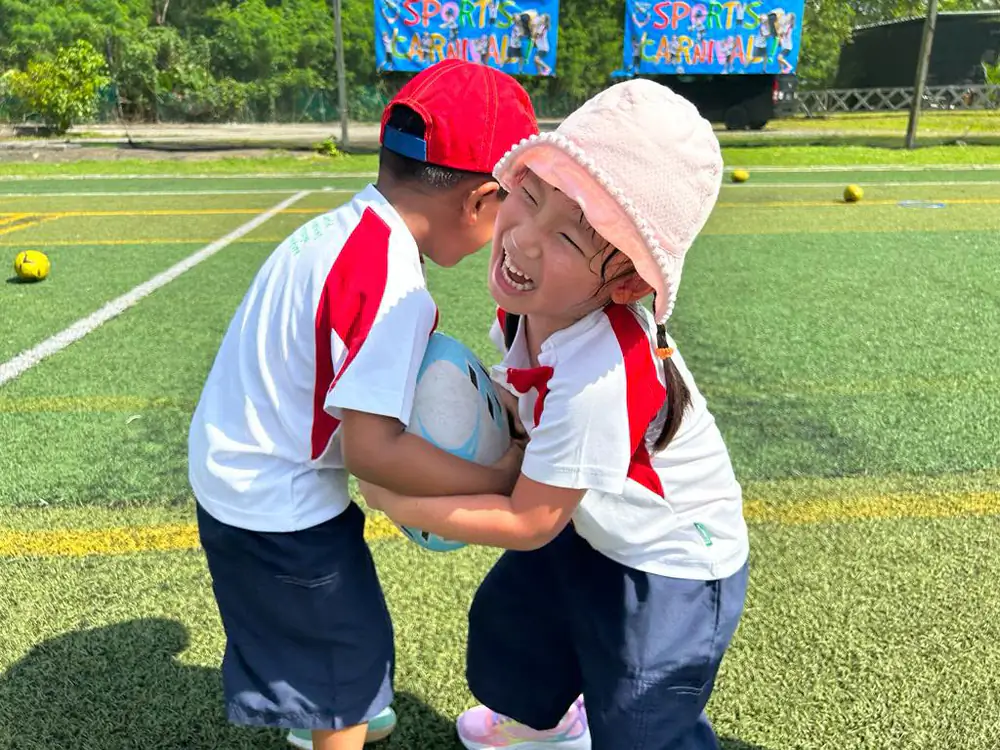
Quick answer: hitting and biting are common between about eighteen months and three and a half, and they are almost always about a child having a strong feeling and no language to release it. They are not a sign of a cruel child or a bad parent. What stops it is consistency, supervision, teaching the words, and removing the situations that reliably trigger it.
Few phone calls land quite like this one. Your child bit someone at preschool. Behind the practical information there is usually a wave of shame, and often a question the parent does not say out loud: what does this mean about my child, or about me?
Almost always, the answer is: not what you fear.
Why young children do it
Between about eighteen months and three, a child has enormous feelings, very little language, and almost no impulse control. They want the truck. Another child has the truck. There is a surge of frustration and no route to express it, and the body does something.
Common drivers:
- No words yet. Hitting is what happens when a child cannot say stop, mine or move.
- Frustration. Something is too hard, too slow, or has just been taken.
- Overwhelm. Too loud, too crowded, too close. A crowded room is a common trigger.
- Tiredness and hunger. The most reliable predictors of a difficult hour anywhere.
- Experiment. Occasionally a young toddler is testing what happens. The reaction is fascinating.
- Teething or sensory need. Some biting is about the mouth rather than the situation.
- Big life changes. A new sibling, a move, a change of room at school.
Notice that none of these is malice. The capacity for genuine cruelty is not there yet.
What to do in the moment
Go to the child who was hurt first. This matters more than it seems. It shows where attention goes and removes the reward of a dramatic reaction.
Be short and clear with your child. "No biting. Biting hurts." Two sentences, firm voice, no long explanation. A lecture is wasted on a two-year-old mid-feeling.
Do not bite them back, or hit them back. It teaches exactly the thing you are trying to stop.
Move them, calmly. Away from the situation, sitting with you for a moment. This is a reset rather than a punishment, and for the under-threes it is more effective than any consequence.
Give the words. "You wanted the truck. You can say: my turn next." Then help them do it. Children need the replacement, not just the prohibition.
Help them repair. Not a forced sorry, which teaches performance. Something real: fetching an ice pack, bringing a different toy, checking the other child is alright.
Then let it go. Do not bring it up all afternoon. Shame does not build self-control.
What reduces it over the following weeks
- Look for the pattern. Time of day, place, particular activity, particular child. Most hitting is far more predictable than it feels, and the pattern is where the solution is.
- Shadow the flashpoints. If it happens over the ride-on toy at ten every morning, be near the ride-on toy at ten.
- Teach the language explicitly. Stop. I do not like it. My turn. Practise it in calm moments and in games.
- Protect sleep and food. Genuinely, half of this problem is fuel.
- Reduce the crowding. More space and more of the popular item prevents more incidents than any amount of teaching.
- Notice the good version. "You waited for your turn. That was hard." Specific and immediate.
- Give a safe outlet. For a biter, something they are allowed to bite. For a hitter, big physical play, running, pushing, carrying heavy things.
- Be boringly consistent. The same response every time, from everyone: parents, grandparents, helper, school. Consistency is what ends it, not severity.
If your child was the one who was hurt
This is hard, and the feelings are legitimate. A few things are worth knowing.
The school will not tell you which child did it. That is not evasion, it is the same protection your child would get if the roles were reversed, and one day they might be.
What you can reasonably ask is: what happened, how was it handled, and what is being put in place. A good preschool will answer all three clearly.
And it is worth resisting the urge to give your child a label for the other child. Two-year-olds do not have enemies. They have bad moments, usually over a truck.
What we do
We supervise closely at the ages where this is common, we watch for the patterns, we adjust the environment, and we teach the words relentlessly. We record incidents and we tell families. We do not shame children, because a shamed child does not learn self-control, they learn to hide.
Most importantly, we treat it as a stage rather than a character. Almost every child who bites at two is completely finished with it by three and a half, and no one remembers.
Shaws Preschool has guided children through the toddler years across the East Coast and Serangoon since 1989. Come and see how our teachers handle the difficult moments: book a tour.