Quick answer: the children who settle fastest into Primary One are not the ones who read earliest. They are the ones who can manage themselves: open their own things, ask for help, wait, cope with not being first, and recover from a setback. Those skills can be built in a year, and mostly at home.
Ask any experienced Primary One teacher what makes the first term go well and you will not hear much about phonics. You will hear about children who can find their own bag, who put a hand up when they are lost, and who can get through a morning without falling apart.
Academics catch up quickly. Self-management does not, and it is the thing school runs on.
Independence, the very practical kind
A Primary One classroom has around thirty children and one teacher. Every small task a child cannot do alone is a task that has to wait.
Worth practising in the year before:
- Toilet independence. Going alone, wiping, flushing, washing hands, managing buttons and zips. This is the single most common thing teachers wish more children arrived able to do.
- Eating and drinking alone. Opening containers, unscrewing a bottle, using cutlery, finishing within a set time. Practise the actual containers you will send, because plenty of children go hungry rather than ask.
- Dressing. Shoes, socks, buttons, changing for PE, hanging things up.
- Looking after belongings. Knowing what is in their bag, packing it themselves, recognising their own things.
- Money and canteen. Holding money, queuing, ordering, counting change. Practise this at a hawker centre with a real transaction.
None of this is difficult. It just needs practising before it is needed, and it needs an adult who will stand back and let it take four minutes.
Asking for help
This one is underrated. A child who will say "I do not understand" or "I need the toilet" in front of thirty people has a substantial advantage.
Build it by making questions welcome at home, by not always anticipating what they need, and by letting them do their own asking in shops, at the doctor and at the counter. Practise the actual sentences: excuse me, I need help; I have finished; can I go to the toilet please.
Self-regulation
The capacity to wait, to stop, to sit through something dull and to recover from disappointment is the strongest predictor of a smooth start.
You cannot teach it with a lecture, but it is built constantly through ordinary life: board games with rules and turns, waiting for a snack, losing a race and being alright afterwards, finishing a task that got boring in the middle.
Sleep matters here more than most parents expect. A tired child has almost no regulation left, and Primary One mornings start early.
Social skills
Joining a group. Sharing space. Taking turns. Managing a disagreement without an adult solving it. Making a friend, and coping on the days when the friend plays with someone else.
These are learned by having many hours with other children, in situations where adults do not immediately intervene. It is one of the strongest arguments for a preschool with plenty of free play in it, rather than a timetable of instructed activities.
Attention and persistence
School will ask a child to stay with something they did not choose, for longer than they would like.
The way to build that is not to make them sit still. It is to let them get deeply absorbed in things they do choose, for long uninterrupted stretches, over several years. A child who has spent four years building, drawing and constructing for forty minutes at a time has trained their attention. A child whose day was chopped into short adult-led segments has not.
Physical readiness
Handwriting needs a stable core and shoulder, and both are built by climbing, hanging, carrying and crawling rather than by pencil practice. Ball skills and general coordination matter too, because PE and the playground are where friendships form.
And yes, some literacy and numeracy
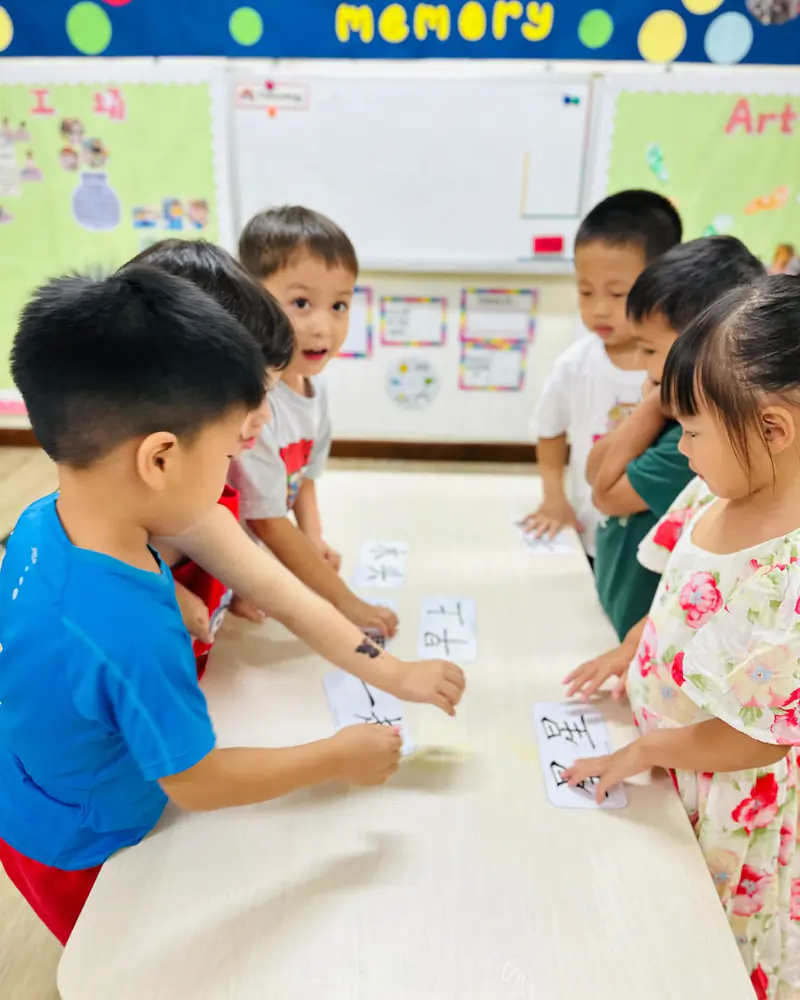
We are not pretending it is irrelevant. Before Primary One it helps if a child can recognise and write their own name, knows most letter sounds, can count and compare small quantities, enjoys books, and can talk about a story.
That is a much shorter list than most families assume, and every item on it can be reached through play, conversation and reading aloud. If your child arrives able to read fluently, that is lovely. If they arrive curious and confident, that is more useful.
What to do in the last few months
- Practise the actual routine: the uniform, the shoes, the bag, the water bottle, an earlier wake-up.
- Walk or ride the route to the school and look at the building.
- Talk about the day in concrete terms: assembly, recess, the toilet, home time.
- Read books about starting school.
- Let them do more for themselves at home, even though it is slower.
- Keep your own anxiety private. Children absorb it, and Primary One registration season makes it hard.
- Say the true thing: everyone will be new, and the teacher's job is to help.
What our K2 year is for
Our final preschool year is deliberately aimed at this. Children take responsibility for their own belongings, manage their own toileting and eating, work in longer blocks, take on jobs in the room, and practise the specific things a Primary One classroom will ask of them.
They leave able to read and count. More importantly, they leave able to look after themselves, ask for what they need, and get on with people. That is what makes the first term feel manageable, for them and for you.
Shaws Preschool has prepared children for Primary One across the East Coast and Serangoon since 1989. Come and see what our K2 year looks like: book a tour.